community-based, non-corporate, participatory media
Making art of resistance in Quito
by Jay
Friday, Oct. 25, 2002 at 6:53 PM
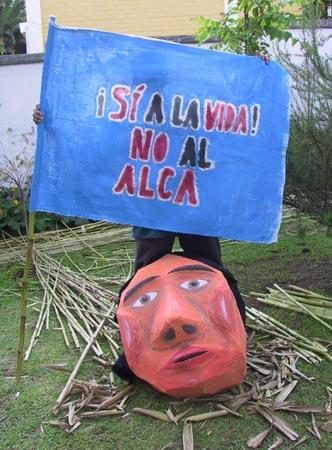
Artists and activists from Ecuador, Colombia, the United States, and all over the world are creating artwork around the clock at the office of Acci�n Ecol�gica for the upcoming mobilization against the FTAA. Giant Puppets representing youth, women, the indigenous, campesinos, and others will march through the streets of Quito with flags declaring "S� A La Vida! No Al ALCA" (Yes to Life! No to FTAA!).
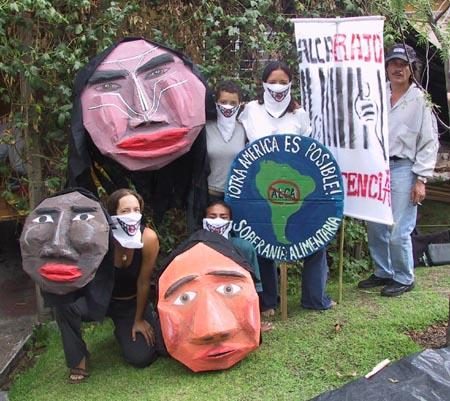
(by Neala Byrne- originally posted on imc-ecuador)
The sun was shining on hundreds of bamboo poles, dozens of flags, banners and freshly painted puppet heads when I arrived at the office of Acci�n Ecol�gica. Every day from 9:30am to 10:30pm, artists and activists from Ecuador, Colombia, the United States, and other parts of the world can be found creating artwork for the upcoming mobilization against the 7th Summit of the Free Trade Area of the Americas (FTAA or ALCA in Spanish). Aryeh, who works with California-based Art & Revolution, took me on a tour of the works-in-progress.
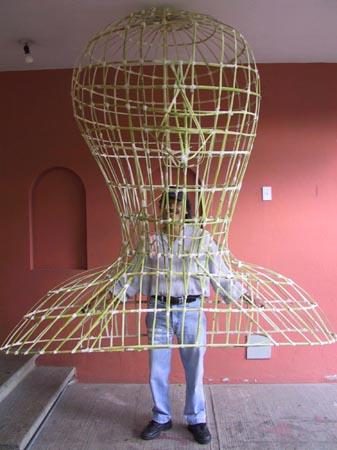
The indoor and outdoor workshops were filled with larger-than-life representations of communities and individuals affected by and shouting out against the FTAA. Giant puppets representing youth, women, the indigenous, campesinos, and others will march through the streets of Quito with flags declaring "S� A La Vida! No Al ALCA" (Yes to Life! No to FTAA!). Amidst the half-finished representations of communities to be cherished, I spotted a gigantic head made out of bamboo which, I was later told, will be transformed into a puppet of "Vampire Bush".
These artists are working around the clock to fill the streets with circular earth signs emblazoned with "Otra America Es Posible" (Another America Is Possible), offering alternatives and solutions such as healthcare, education, gender equality, and solar energy. These new and "possible" worlds are painted with demands such as: "Derechos Ind�genas" (Indigenous Rights), "Soberania Almentaria (Food Sovereignty) and "Amazonia Libre De Petrol" (Amazon Free of Petroleum).
An artist/activist from Mindo, where the OCP pipeline is threatening to destroy his way of life, explained that it is difficult for him to get information onto the radio about the FTAA because it is difficult to get political information on the radio at all. Aryeh added that, although it has been difficult for organizers to circulate information about the FTAA, the impacts of globalization are much clearer here than in the United States. In this country, dollarization has damaged the lives of the poor and middle class alike, while 80% of the rural population lives in poverty, The Ecuadorian government�s long history of compliance with the policies of the International Monetary Fund and World Bank have driven the economy further and further into decline.
As I left, heavy rain began to fall on all of the materials and creations for the protest. It is a tough time in history to be organizing, and it is the rainy season in Ecuador. Without missing a beat, people began pulling their projects inside as a student group from Quito arrived to work on street theatre for the protests. I overheard some of the discussion that had begun between the students and artists, as I walked out into the rain. This talk was not about difficulties, but about possibilities.
more
by Jay
Friday, Oct. 25, 2002 at 6:54 PM
more
by Jay
Friday, Oct. 25, 2002 at 6:54 PM
| TITLE | AUTHOR | DATE |
|---|---|---|
| another nice picture from quito | john | Friday, Oct. 25, 2002 at 7:00 PM |
| 2nd picture | jay | Friday, Oct. 25, 2002 at 6:56 PM |
