community-based, non-corporate, participatory media
S.Odamninsane - ity
by S.Odamninsane
Friday, Apr. 11, 2003 at 2:57 PM
For years we were subjected to reporting on the situation in Iraq that clearly soft-pedaled and often ignored the real atrocities and threats of the Hussein regime. And always this reporting was offered up as far more reliable than our own government sources. AND this reporting is used to protest intervention in, and the use of force to stop, one of the worst human rights crisis of this short century. But now the truth can be told ... and still there are people out there that find some way to impose the sins of Hussein, the rape of Iraq, and the hatred of the Arab despots on the United States. That is insanity !!!
The News We Kept to Ourselves
By EASON JORDAN
TLANTA — Over the last dozen years I made 13 trips to Baghdad to lobby the government to keep CNN's Baghdad bureau open and to arrange interviews with Iraqi leaders. Each time I visited, I became more distressed by what I saw and heard — awful things that could not be reported because doing so would have jeopardized the lives of Iraqis, particularly those on our Baghdad staff.
For example, in the mid-1990's one of our Iraqi cameramen was abducted. For weeks he was beaten and subjected to electroshock torture in the basement of a secret police headquarters because he refused to confirm the government's ludicrous suspicion that I was the Central Intelligence Agency's Iraq station chief. CNN had been in Baghdad long enough to know that telling the world about the torture of one of its employees would almost certainly have gotten him killed and put his family and co-workers at grave risk.
Working for a foreign news organization provided Iraqi citizens no protection. The secret police terrorized Iraqis working for international press services who were courageous enough to try to provide accurate reporting. Some vanished, never to be heard from again. Others disappeared and then surfaced later with whispered tales of being hauled off and tortured in unimaginable ways. Obviously, other news organizations were in the same bind we were when it came to reporting on their own workers.
We also had to worry that our reporting might endanger Iraqis not on our payroll. I knew that CNN could not report that Saddam Hussein's eldest son, Uday, told me in 1995 that he intended to assassinate two of his brothers-in-law who had defected and also the man giving them asylum, King Hussein of Jordan. If we had gone with the story, I was sure he would have responded by killing the Iraqi translator who was the only other participant in the meeting. After all, secret police thugs brutalized even senior officials of the Information Ministry, just to keep them in line (one such official has long been missing all his fingernails).
Still, I felt I had a moral obligation to warn Jordan's monarch, and I did so the next day. King Hussein dismissed the threat as a madman's rant. A few months later Uday lured the brothers-in-law back to Baghdad; they were soon killed.
I came to know several Iraqi officials well enough that they confided in me that Saddam Hussein was a maniac who had to be removed. One Foreign Ministry officer told me of a colleague who, finding out his brother had been executed by the regime, was forced, as a test of loyalty, to write a letter of congratulations on the act to Saddam Hussein. An aide to Uday once told me why he had no front teeth: henchmen had ripped them out with pliers and told him never to wear dentures, so he would always remember the price to be paid for upsetting his boss. Again, we could not broadcast anything these men said to us.
Last December, when I told Information Minister Muhammad Said al-Sahhaf that we intended to send reporters to Kurdish-controlled northern Iraq, he warned me they would "suffer the severest possible consequences." CNN went ahead, and in March, Kurdish officials presented us with evidence that they had thwarted an armed attack on our quarters in Erbil. This included videotaped confessions of two men identifying themselves as Iraqi intelligence agents who said their bosses in Baghdad told them the hotel actually housed C.I.A. and Israeli agents. The Kurds offered to let us interview the suspects on camera, but we refused, for fear of endangering our staff in Baghdad.
Then there were the events that were not unreported but that nonetheless still haunt me. A 31-year-old Kuwaiti woman, Asrar Qabandi, was captured by Iraqi secret police occupying her country in 1990 for "crimes," one of which included speaking with CNN on the phone. They beat her daily for two months, forcing her father to watch. In January 1991, on the eve of the American-led offensive, they smashed her skull and tore her body apart limb by limb. A plastic bag containing her body parts was left on the doorstep of her family's home.
I felt awful having these stories bottled up inside me. Now that Saddam Hussein's regime is gone, I suspect we will hear many, many more gut-wrenching tales from Iraqis about the decades of torment. At last, these stories can be told freely.
Eason Jordan is chief news executive at CNN.
So What The Hell Was Peter Arnett All About ???
by -
Friday, Apr. 11, 2003 at 4:24 PM
If CNN was so concerned why the hell were they so clueless in their "unbiased" reporting. Thank God for Fox News !!!!
FOX NEWS
by Cool Kid
Friday, Apr. 11, 2003 at 4:50 PM
I like Fox News... it's nice!
Keep up the good work
by Freepers creepers
Friday, Apr. 11, 2003 at 7:18 PM
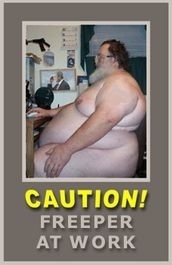
Return the favor.
Return the favor
by Freepers creepers
Friday, Apr. 11, 2003 at 7:22 PM
A great way to 'search' Free Republic.
seattle.indymedia.org/front.php3?article_id=25729&group=webcast
Actually, He looks like a liberal college professor
by Bertha Butt
Friday, Apr. 11, 2003 at 8:27 PM
So the picture is obscene. I don't expect this sort of potty humor here. What is a "Freeper" anyway?
Dear Freeper Creeper,
by 2balls
Saturday, Apr. 12, 2003 at 10:24 AM
Please stop posting items from your personal porn collection.
2 balls 0 brain
by Freepers creepers
Saturday, Apr. 12, 2003 at 11:45 AM
You didn't know we have a camera set up in you mom's basement, and we're watching you. We even followed you the time you left the house 3 weeks ago with your mother to buy new sweatpants, since you soiled your other ones.
CNN and the Liberal Press Are Worthless
by Tom Brokejaw
Saturday, Apr. 12, 2003 at 2:27 PM
That whole story is appalling. CNN was aware of all of this the whole time they were apologizing for the Hussein Regime. CNN was more concerned with their ratings and access than for people. They don't care about doing the right thing. And they want us to belieev they were unbiased. Yeah, right. Just like the reporters in Baghdad with their Saddam appointed "minders" were not biased. It figures tah CNN is controled by Hanoi Jane Fonda and lunatic hubby ted Turner.
.
by .
Monday, Apr. 14, 2003 at 8:04 AM
It figures tah CNN is controled by Hanoi Jane Fonda and lunatic hubby ted Turner.
Actually they're not married anymore, it's not a big deal and shouldn't be mentioned on IndyMedai except to point out that again, this is another statement void of fact.
MORE ON CNN CORUPTION !!!
by Mulder N. Scully
Wednesday, Apr. 16, 2003 at 11:52 AM
Corruption at CNN
Peter Collins
Mr. Eason Jordan's admission that CNN had to suppress the news from Baghdad in order to report it brought back memories for me.
In January 1993, I was in Baghdad as a reporter for CNN on a probationary, three-month contract. Previously, I had been a war reporter for CBS News in Vietnam and East Asia and in Central America for ABC News. I had also made three trips to Baghdad for ABC News before the Gulf War.
Now, Bill Clinton was about to be inaugurated and there was speculation that Saddam Hussein might "test" the new American president. Would the new administration be willing to enforce the "no-fly" zones set up in northern and southern Iraq after the Gulf War?
CNN had made its reputation during the war with its exclusive reports from Baghdad. Shortly after my arrival, I was surprised to see CNN President Tom Johnson and Eason Jordan, then chief of international news gathering, stride into the al-Rasheed Hotel in Baghdad. They were there to help CNN bid for an exclusive interview with Saddam Hussein, timed to coincide with the coming inauguration of President Clinton.
I took part in meetings between the CNN executives and various officials purported to be close to Saddam. We met with his personal translator; with a foreign affairs adviser; with Information Minister Latif Jassim; and with Deputy Prime Minister Tariq Aziz.
In each of these meetings, Mr. Johnson and Mr. Jordan made their pitch: Saddam Hussein would have an hour's time on CNN's worldwide network; there would be no interruptions, no commercials. I was astonished. From both the tone and the content of these conversations, it seemed to me that CNN was virtually groveling for the interview.
The day after one such meeting, I was on the roof of the Ministry of Information, preparing for my first "live shot" on CNN. A producer came up and handed me a sheet of paper with handwritten notes. "Tom Johnson wants you to read this on camera," he said. I glanced at the paper. It was an item-by-item summary of points made by Information Minister Latif Jassim in an interview that morning with Mr. Johnson and Mr. Jordan.
The list was so long that there was no time during the live shot to provide context. I read the information minister's points verbatim. Moments later, I was downstairs in the newsroom on the first floor of the Information Ministry. Mr. Johnson approached, having seen my performance on a TV monitor. "You were a bit flat there, Peter," he said. Again, I was astonished. The president of CNN was telling me I seemed less-than-enthusiastic reading Saddam Hussein's propaganda.
The next day, I was CNN's reporter on a trip organized by the Ministry of Information to the northern city of Mosul. "Minders" from the ministry accompanied two busloads of news people to an open, plowed field outside Mosul. The purpose was to show us that American warplanes were bombing "innocent Iraqi farmers." Bits of American ordinance were scattered on the field. One large piece was marked "CBU." I recognized it as the canister for a Cluster Bomb Unit, a weapon effective against troops in the open, or against "thin-skinned" armor. I was puzzled. Why would U.S. aircraft launch CBUs against what appeared to be an open field? Was it really to kill "innocent Iraqi farmers?" The minders showed us no victims, no witnesses. I looked around. About 2000 yards distant on a ridgeline, two radar dishes were just visible against the sky. The ground was freshly plowed. Now, I understood. The radars were probably linked to Soviet-made SA-6 surface-to-air missiles mounted on tracks, armored vehicles, parked in the field at some distance from the dishes to keep them safe. After the bombing, the Iraqis had removed the missile launchers and had plowed the field to cover the tracks.
On the way back to Baghdad, I explained to other reporters what I thought had happened, and wrote a report that was broadcast on CNN that night.
The next day, Brent Sadler, CNN's chief reporter at the time in Baghdad (he is now in northern Iraq), came up to me in a hallway of the al Rasheed Hotel. He had been pushing for the interview with Saddam and had urged Mr. Johnson and Mr. Jordan to come to Baghdad to help seal the deal. "Petah," he said to me in his English accent, "you know we're trying to get an interview with Saddam. That piece last night was not helpful."
So, we were supposed to shade the news to get an interview with Saddam?
As it happens, CNN never did get that interview. A few months later, I had passed my probationary period and was contemplating my future with CNN. I thought long and hard; could I be comfortable with a news organization that played those kinds of games? I decided, no, I could not, and resigned.
In my brief acquaintance with Mr. Jordan at CNN, I formed the impression of a decent man, someone with a conscience. On the day Mr. Jordan published his piece in the New York Times, a panel on Fox News was discussing his astonishing admissions. Brit Hume wondered, "Why would he ever write such a thing?" Another panelist suggested, "Perhaps his conscience is bothering him." Mr. Eason, it should be.
Peter Collins has more than 30 years of experience in broadcast news, including outlets such as the Voice of America, BBC, CBS, ABC and CNN
http://www.washingtonpost.com
LAST TIME I WATCHED CNN
by Prodigal Yunzer
Wednesday, Apr. 16, 2003 at 12:00 PM
Was after Bush's state of the union, when he mentioned hydrogen powered autos. They had a woman reporter with two old geezer activist-oriented scientists with a big stage and a model of a hydrogen car. This big haired meat puppet, who probably makes a good salary, asked the old duffer "So where does the oxygen change into hydrogen?"
Thye looked at her with shock and awe. Uh, the same place we change your gum wrappers into 24 karat gold, honey. Put it in the alchemy chamber.
You can't call CNN "broadcast journalism" because it is neither boradcast nor do they employ many journalists. Have you seen the woman who covers the White House for them lately? She looks and sounds like a weather girl. At least you knew that "I Ate All The Candy" Crowley wasn't there because of her good looks.
Broadcast Journalism
by Jackel
Wednesday, Apr. 16, 2003 at 3:45 PM
I don't think there is such a thing left on the tube. I hate traveling because every Marriott exercise room has CNN on and it's a joke. For a while, I thought that Fox was better but now I'm second-guessing myself. They are better than CNN and others but still a far cry from "broadcast journalism." Relative to magazines, CNN is akin to "People" and Fox is more like "Time" or "Newsweek." I'm going to continue reading the Wall Street Journal for my information and keep digital cable around only for Letterman and the Spice channel.
