community-based, non-corporate, participatory media
Sudden Climate Change is the historical norm
by Brent Herbert
Sunday, Sep. 14, 2003 at 12:20 PM
Past climates changed abruptly, suggesting that abrupt changes in the future will also occur, according to a Penn State geoscientist, Dr. Richard B. Alley, the Evan Pugh professor of geosciences at Penn State. Current models all tend to change smoothly and do not capture abruptness ... The Penn State geoscientist suggests that climate change includes a process of approaching and crossing a series of thresholds
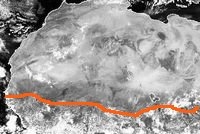
On the diagram above, I have sketched out approximately the extent of the Sahara during 1990 (using a red line) superimposed on the current extent of the desert during September 2003. It was around 1997 that my research indicates the changes actually began to occur, with the decline of the American forest beginning concurrent with the increasing rainfall in the Sahara region, and now the process is so well along, that the retreating Sahara is now impossible to miss, becoming plainly visible on Satellite images.
related links
America's Unhealthy Forests
http://www.awitness.org/journal/drought_sept_2003.html
Sahara climate change brings catastrophic floodings
http://www.awitness.org/journal/sahara_floods.html
Rivers in the region are currently carrying up to 8 times the normal water for a rainy season and are at just below flood stage with the possiblity of crop destruction for millions along their banks due to further torrential rains in the forecast.
http://www.awitness.org/journal/sahara_flood_famine.html
Rapid changes in climate are being observed in the Sahara region. The changes are most remarkable this year, although if you examine the pattern going back to the late 90s, you would see a suddenly emerging pattern of increased rainfalls, record breaking harvests along the Southern border, and now the retreat of the desert. The Sahara has been a vast desert for the last six thousand years, and previous to that time, when it was a lush Eden, the Global temperature was only about one or two degrees warmer than in the following epoch. And this is about how much human society has been pushing up the global temperature in the modern age.
I spoke about sudden rapid change in the climate being the norm throughout history, and not slow gradual change in the climate, which, based on what they keep being told by climate computers, is what most people seem to expect to happen. That would be abnormal if such gradual change did happen, since that is not what typically has happened to the climate throughout history. Sudden, abrupt climate change is the norm, and this is not well modeled by climate computers.
For example, the Climate Change 2001 project discussed this weakness in climate predicting models in their paper, in the section discussing thresholds. Over history, the climate remains stable, and no effects are noticed, until suddenly a certain threshold is crossed and then rapid climate change takes place.
___________________________________________________________________
Climate Change 2001:
Working Group II: Impacts, Adaptation and Vulnerability
Chapter One
1.4.3.5. Thresholds
http://www.grida.no/climate/ipcc_tar/wg2/061.htm
"In many environmental fields, there are thought to be thresholds below which only minor effects occur...and are incorporated into some models as �tolerable� levels that must be exceeded before significant impacts occur...Below the threshold, there may be some impacts, but they will be smoothly varying with the change in climate. Some positive effects might even be observed in some regions or sectors for a small global warming, giving the impression that there is little impact. Above the threshold, however, potentially damaging events may occur...Although such threshold events remain somewhat speculative, their impacts clearly would be more severe than smoothly varying (and thus more adaptable) events...By definition, it is difficult to give examples of the surprises that might be created under a changed climate. Such surprises, however, can make even the most careful calculation of impacts extremely inaccurate, as noted previously...Strongly nonlinear responses are characterized by thresholds�which, if exceeded by a stimulus, result in substantially greater sensitivity to further stimulus or dramatic change, explosive growth, or collapse. Complex responses involve interactions of many intricate elements that yield outcomes that are not easily predicted...Advances in our understanding of these types of responses are largely qualitative, but they are important in understanding the character of dangers posed by climate change. Omission of potential nonlinear and complex responses from climate change impact assessments is expected (well-established, but incomplete) to yield underestimates of impacts."
____________________________________________________________________
In the past the climate behaved according to this principle of reaching a certain threshold and then changing abruptly. This is the typical pattern over the course of climate history and it is not modeled by current computer simulations of the climate that make predictions about smooth transitions, for, as the authors above note, the process is not well enough understood, and thus tends to be 'speculative'. What they mean here is that basically someone just has to guess, and that guessing is considered bad science.
Abrupt climate change is the norm, and not this smooth linear change predicted by current climate models. As the researchers of the paper above noted, much more research needs to be done on this question of thresholds, and the possibility for sudden surprises and changes of sudden non-linear changes in the climate are therefore one of the great unknowns in current climate research. In otherwords, one finds out where the threshold was when one reaches the threshold, and then crosses the threshold, or so it would seem.
_____________________________________________________________________
Sharper Warning on chance of abrupt climate changes
http://unisci.com/stories/20014/1214011.htm
"Past climates changed abruptly, suggesting that abrupt changes in the future will also occur, according to a Penn State geoscientist. �When we look at records of the past, climate often changed abruptly rather than smoothly,� says Dr. Richard B. Alley, the Evan Pugh professor of geosciences at Penn State. �This is true wherever and whenever you look.� ... Alley, who is currently chairing the National Academy of Science Committee on Abrupt Climate Change: Science and Public Policy, told attendees Thursday (Dec. 13) at the fall meeting of the American Geophysical Association in San Francisco, that while studies of ice cores, sediments and other relics of the past indicate these abrupt changes, the models currently used by those predicting the future of climate change do not do a good job of simulating abrupt changes in the past ... In the long term, abrupt change appears to be the norm. Current models all tend to change smoothly and do not capture abruptness ... The Penn State geoscientist suggests that climate change includes a process of approaching and crossing a series of thresholds...With climate, the thresholds in the past have sometimes been reached in as few as 10 years ... Any reality may be very different from the predictions and we need to anticipate changes and surprises."
________________________________________________________________
The professor uses an analogy of adding building blocks to a tower. The tower remains stable for some time, until that very last block is placed upon it, which destablizes the tower and causes it to collapse suddenly. Basically what happens is that, for example, you can keep adding CO2 to the atmosphere and not much really seems to happen. Then suddenly, as in the past, there is this immediate abrupt change. This is how the climate changed in the past, and as the professor notes, the changes can take place over the course of a single decade, before the climate reaches a new state of equilibrium.
The climate models are often programmed in a linear fashion so that they simply extrapolate the past into the future, and thus given the small changes that occur, they can come back with a prediction that the climate change will take place in say, 50 or 100 years. (There are three different methods of modeling climate on computers, by the way, and this would not be the only method). One of the reasons that these computers tend to be this linear is because due to the current state of scientific knowledge, programming for explosive non-linear changes (which is what actually happens throughout climate history) is not a process that is well understood, and thus involves speculative programming, and thus gives results that no one would really trust. At the same time these linear results that predict gradual climate change over the next century cannot be trusted either, since that is not how climate changes. What current climate computer simulations do not take into account is the concept of thresholds, and the possibility of sudden, surprising climate change, that is unpredictable, and could make almost every climate scenario turn out to be inaccurate in its predictions. As the researchers above noted, given the history of actual climate change, as opposed to computer simulated climate change, the kinds of changes that can occur can, in their words, "result in substantially greater sensitivity to further stimulus or dramatic change, explosive growth, or collapse."
This model of suddenly reaching the threshold and then going through sudden, surprising, non-linear climate change seems to me to be the best explanation for what is currently happening to the world's climate. The forests of the United States are extremely unhealthy, and this is so obvious that trees have been moved to the top of the Republican Agenda in White House (right up there with the Iraq war, and the reason is obvious, if you look down on America from space, and study all the drought indicators). Now there is some spin doctoring occuring here, and some butt covering as well, for when devestating forest fires occur, it can be blamed on those 'damned tree huggers' who wouldn't let us 'thin the forests'. Actually forest thinning is not the solution, espcially given the enormous size of that unhealthy ecosystem (according to my back of the napkin calculation, given current stats, if you start now you might get done by the end of the century). Furthermore, tree huggers are not the source of the problem, rather climate change is the source of the problem, since if your trees were healthy they wouldn't be in danger of burning to the ground like they are now. Even a one degree warming of the Pacific results in catastrophic droughts in the American Western Forests. Even supposing you could 'thin trees' that wouldn't even come close to addressing the real problem with your unhealthy forests.
Similarly there are now rapid changes taking place on the Sahara. Now the Sahara is the most useful indicator enviroment on earth, for a couple of reason. The ocean is a major sink of CO2 and when it sinks to much CO2 you get an ice age, the ocean cover is reduced, CO2 is then free to build, the ice age ends, and the process starts again. The global temperature dropped by about a degree or two, due to this sinking of CO2, and one of the results was the destruction of this Eden and the appearance of the Sahara in its place, which has been one of the stable features of the current climatic age for the last six thousand years.
Therefore, when the Sahara disappears, it can no longer be said that there is no global warming. One could say, of the American forest, that 'it is just another drought, happens all the time'. One cannot say, 'its just another rebirth of the Sahara, happens all the time.' This indicator environment has been stable for six thousand years. What this would indicate is that enough CO2 has been pumped into the atmosphere to turn back the clock at least 8,000 years, and only a small change in global temperature, like a degree or so, is enough to make all the difference in the world, both to American forests and to the Sahara, which was an Eden just a short time ago, when there was more CO2. The American west contains significant desert and marginal savannah, and that these areas have been contained over the last 6,000 years has a lot to do with that critical drop of a degree in the temperature of the Pacific, so one can then assume that the range of desert in the american west will increase, and that certainly has been the trend since the late nineties, when both the western forests began their decline and, not coincidentally, the Sahara region began to improve. That these two indicator environments began changing both at the same time is one of the most telling indicators that this is not just 'business as usual'.
These changes take place rapidly, once the threshold has been crossed, as history indicates, and so the best explantion for what is now taking place is that we have in fact crossed the threshold, in fact, we crossed the threshold in the late nineties, and now rapid climate change is taking place, RIGHT NOW, and not in 50 or 100 years, as people have been led to believe.
It is interesting to note that further global warming on this scale is a particularly bad idea as noted above since "Strongly nonlinear responses are characterized by thresholds�which, if exceeded by a stimulus, result in substantially greater sensitivity to further stimulus." What this means is that once you cross one of those invisible thresholds, you can no longer expect no response but rather further 'stimulation' results in 'strongly non-linear responses'. Just what this means in actual practice remains to be seen, and given how stubbornly resistant to all change the current monetary system really is (based as it is on powerful feuding special interests and singular concern with money) I guess we will be finding out, as the earth becomes a giant lab experiment.
ozone hole
by brent
Sunday, Sep. 14, 2003 at 1:25 PM
We all know how ozone is affected by CFCs and this makes one wonder why so many people have been convinced by pro big oil propaganda to believe that CO2 isn't a problem...
A recent reuters report, from September 12, 2003, detailed the expansion of the ozone hole...
http://www.cnn.com/2003/TECH/science/09/12/ozone.layer.reut/
Antarctic ozone hole sets record
LONDON (Reuters) -- The gaping, man-made hole in the ozone layer over Antarctica has hit record proportions for this time of year and could get bigger still within the next few days, a leading scientist said on Friday. At just short of 28 million square kilometers, the hole is a fraction under the absolute record of 28.5 million.
Reuters also reported that "The consequent drop in output of these chemicals (CFCs) began to bite in 1994 and is now some six percent down on its peak." In otherwords, if I understand this correctly, we are now belching out only 94 per cent of the ozone destroying chemicals as we once did. That reminds one of the modest reductions of something like 6 per cent that was supposed to be the Kyoto accord, and which everything thought was an accomplishment, but even that modest reduction turned out to be more than the current profit driven management of the planet could stand (at least as far as the U.S. goes).
You should keep in mind that plants get stunted and crops fail when exposed to UV radiation which comes right through that ozone hole, leading to famine and so on. Fortunately, for humanity, no one is farming antartica or the north pole, but if we are still pumping out CFCs it makes a person wonder...
sahara sunset sept 14
by brent
Sunday, Sep. 14, 2003 at 2:34 PM
beautiful
